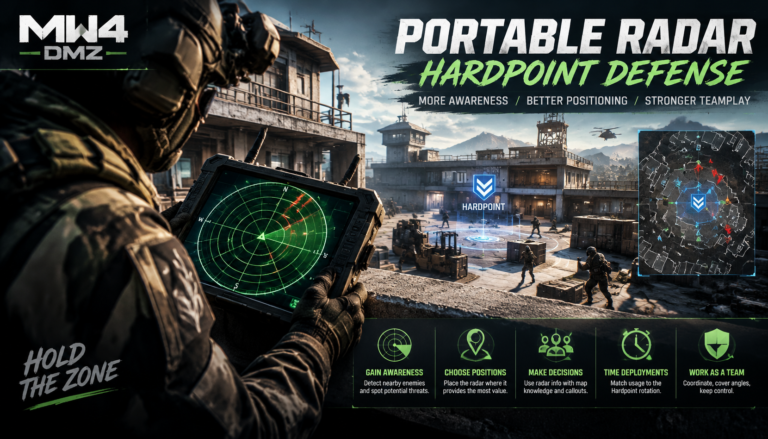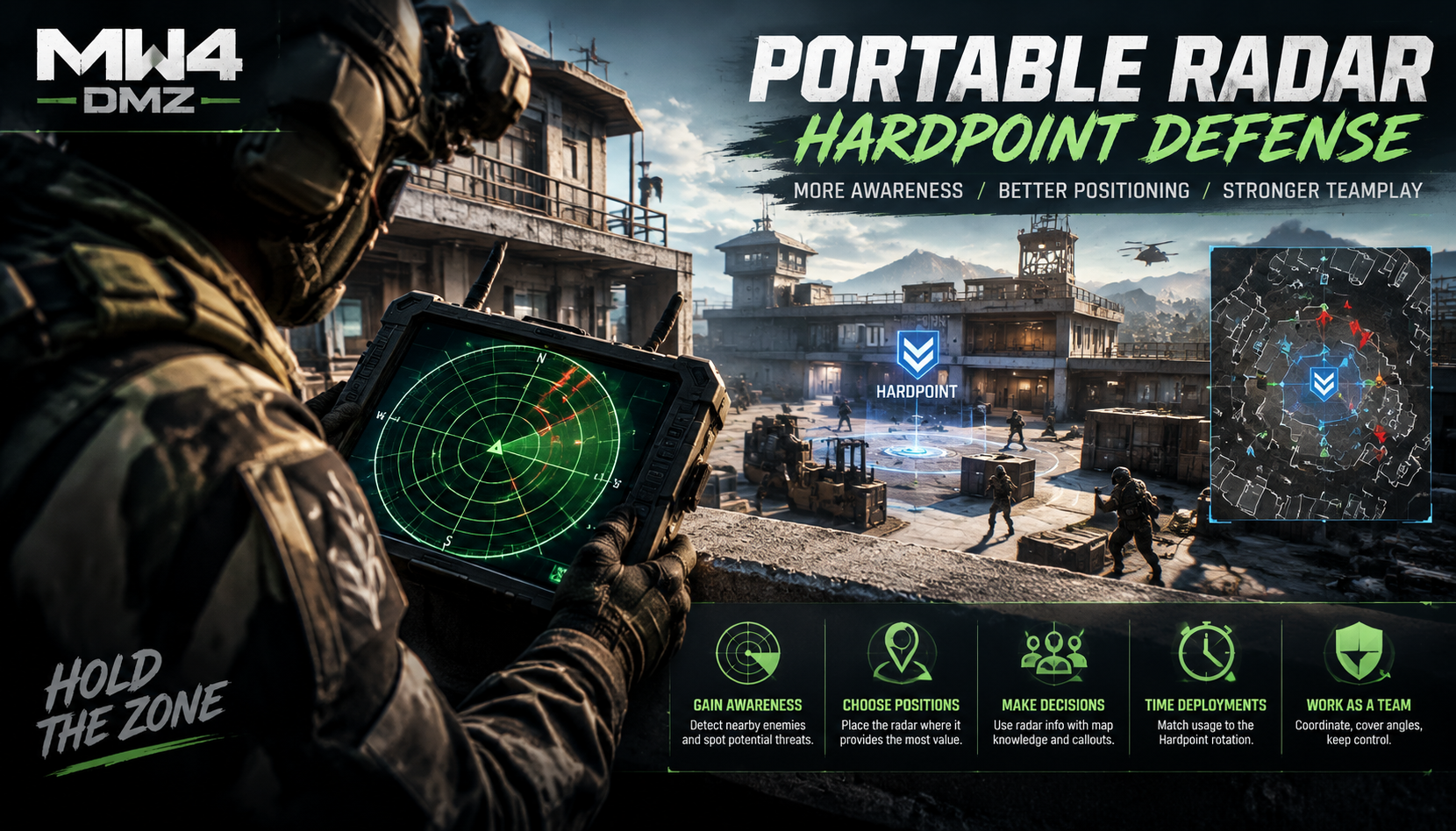
Portable Radar provides an additional source of intelligence in objective-based multiplayer, helping teams monitor nearby enemy movements and respond to incoming pressure. Understanding how equipment resources such as CoD MW4 DMZ Items fit into broader preparation can also help players distinguish between different gameplay priorities. In Hardpoint, Portable Radar offers the greatest value when its periodic scans help defenders assess nearby threats, protect vulnerable entrances, and coordinate their positions before opponents reach the scoring zone.
Why Portable Radar Matters in Hardpoint
Hardpoint requires teams to maintain control of an active scoring zone while preventing opponents from establishing a foothold. Success depends on positioning, timing, and the ability to respond to pressure from multiple directions. Portable Radar supports this process by periodically scanning for nearby enemies, providing defenders with another source of information during contested engagements.
Its primary advantage is improved awareness around vulnerable positions. Rather than relying exclusively on visual contact, defenders can use radar indications to assess potential threats and adjust their coverage. This is particularly useful when a Hardpoint sits inside a building or connects to several corridors and approach routes.
Portable Radar does not provide continuous tracking or guarantee that every approaching opponent will be detected. Its coverage is limited, and a scan cannot establish an enemy’s exact intentions. Combining radar indications with direct observation, map knowledge, and team communication produces a more reliable defensive approach.
Choosing Effective Deployment Positions
Placement determines how much useful information Portable Radar contributes to a defensive setup. Positioning it directly in the center of a contested area may seem convenient, but the best location depends on the map layout, likely enemy approaches, and the angles teammates already cover.
A position near a frequently used entrance or connecting passage can help defenders identify nearby activity without abandoning their assigned angles. Inside a building, a protected corner or adjacent room may offer a useful balance between coverage and equipment survival. On an open objective, prioritizing important approach routes is generally more practical than attempting to monitor every direction.
Three factors deserve particular attention:
- Enemy approach routes: Prioritize entrances, corridors, stairways, and connecting lanes that opponents are likely to use when contesting the objective.
- Equipment protection: Avoid exposed locations where the device can be destroyed before providing meaningful information.
- Team positioning: Coordinate radar coverage with teammates watching other angles to reduce blind spots without leaving important positions unattended.
Effective placement should improve the team’s overall awareness rather than simply generate more minimap activity. When several defenders already cover the same entrance, monitoring a less visible approach may provide greater tactical value.
Turning Radar Information Into Defensive Decisions
Portable Radar becomes more useful when defenders translate its indications into specific actions. Detected activity may signal an approaching opponent, a possible flank, or movement near a route receiving limited attention. However, a scan does not reveal an enemy’s intentions, so players must interpret the information alongside visual cues, recent engagements, and the current state of the objective.
Clear communication allows teammates to respond before opponents establish favorable positions. A concise callout about activity near an entrance can prompt a teammate to check the angle, reinforce a vulnerable side, or prepare for a potential engagement. These adjustments help defenders manage pressure without abandoning the scoring zone unnecessarily.
Radar information can also discourage overcommitment. If activity appears on one side, teammates can adjust their positions while another player remains responsible for the objective. This reduces the chance of multiple defenders pursuing the same target and leaving an opening for an opponent to enter the zone.
Rather than chasing every radar indication, defenders should use the available information to decide where to hold, when to reposition, and which approach requires immediate attention. This discipline becomes particularly important when opponents create distractions before pushing from another direction.
Timing Deployments Around Hardpoint Rotations
Hardpoint forces teams to balance control of the current zone with preparation for the next one. Chasing opponents too far from the objective can weaken the team’s hold, while rotating prematurely may sacrifice valuable scoring opportunities. Portable Radar can support this balance when deployment reflects the team’s immediate priorities.
During an established hold, the device can help defenders assess nearby activity and identify potential pressure. As the next Hardpoint approaches, its value depends on whether the current position remains important or the team needs to shift attention toward a different area.
| Match situation | Deployment priority | Tactical objective |
|---|---|---|
| Initial setup | Cover a likely approach to the active zone | Assess potential threats before opponents enter |
| Established defense | Monitor a vulnerable entrance or flank | Maintain coverage without unnecessary movement |
| Heavy enemy pressure | Help teammates assess nearby activity | Coordinate responses and avoid isolated defenders |
| Approaching rotation | Reassess the value of the current placement | Prepare to reposition while managing the ongoing fight |
| New Hardpoint setup | Consider the new zone’s entrances and connecting routes | Establish useful coverage before the next engagement |
Timing should reflect the match rather than follow a rigid schedule. With a medium recharge rate, Portable Radar is worth saving for situations in which another scan could provide meaningful information. Deploying it simply because it is available may offer less value than using it during a contested defensive phase or a vulnerable transition.
Rotation planning also requires awareness of the team’s overall position. A scan near the current zone may reveal nearby activity, but it should not delay a necessary move toward the next objective. Coordinated equipment use supports the team’s broader plan without distracting players from scoring opportunities.
Balancing Radar Coverage With Other Defensive Priorities
Portable Radar provides information, but it cannot physically prevent opponents from entering the objective. Successful defense also depends on chokepoint control, communication, equipment selection, and rotation planning. Understanding these relationships helps teams determine when radar intelligence addresses their biggest tactical weakness.
| Defensive priority | Main purpose | How Portable Radar contributes |
|---|---|---|
| Objective control | Maintain access to the scoring zone | Helps defenders assess nearby threats |
| Chokepoint coverage | Limit effective enemy approach routes | Provides additional information about monitored areas |
| Team communication | Coordinate defensive responses | Supplies information for timely callouts |
| Equipment protection | Manage incoming grenades and other threats | Supports awareness but does not replace dedicated defensive tools |
| Rotation planning | Prepare for the next Hardpoint | Helps assess nearby activity during transitions |
Portable Radar is a sensible choice when early warning and local awareness are important to the team’s strategy. Other Field Upgrades may be more useful when the main problem involves incoming explosives, ammunition shortages, or electronic disruption. The appropriate choice depends on the map, team composition, and challenges encountered during a match.
A balanced loadout should address the team’s actual needs instead of relying on one piece of equipment to solve every defensive problem. Radar information is most valuable when players already have a clear plan for holding the objective and responding to pressure.
Team Coordination Determines Its Effectiveness
Portable Radar delivers greater tactical value when teammates understand how to use its indications. A defender who notices nearby activity but fails to communicate it gains only a limited advantage. A coordinated team can adjust several positions, reinforce an exposed entrance, or prepare for an engagement while keeping another player focused on the scoring zone.
The device can also encourage more disciplined movement. Instead of leaving the Hardpoint whenever a possible target appears, teammates can evaluate whether repositioning is necessary or whether maintaining the current formation offers greater value. This helps preserve defensive integrity during prolonged engagements and reduces unnecessary gaps around the objective.
Players refining MW4 Hardpoint defense strategies should combine radar information with map awareness, reliable callouts, and clear defensive assignments. Portable Radar cannot replace gun skill or sound positioning, but it can support better-informed decisions when players understand its limitations.
Making Portable Radar Work for Hardpoint Defense
Portable Radar is most effective when each deployment serves a clear tactical purpose. Monitoring a vulnerable entrance, assessing activity near a connecting route, and preparing for an incoming push can all improve a team’s awareness. The strongest results come from matching placement and timing to the map layout while ensuring that teammates know how to respond.
Effective Hardpoint defense requires teams to manage enemy approaches, maintain overlapping coverage, and prepare for rotations without surrendering control unnecessarily. Portable Radar supports these responsibilities when used with discipline. Players exploring CoD MW4 Bot Lobbies can also use suitable practice settings to work on positioning, target awareness, and fundamental combat skills, depending on the available modes and configuration options.
About the Author